
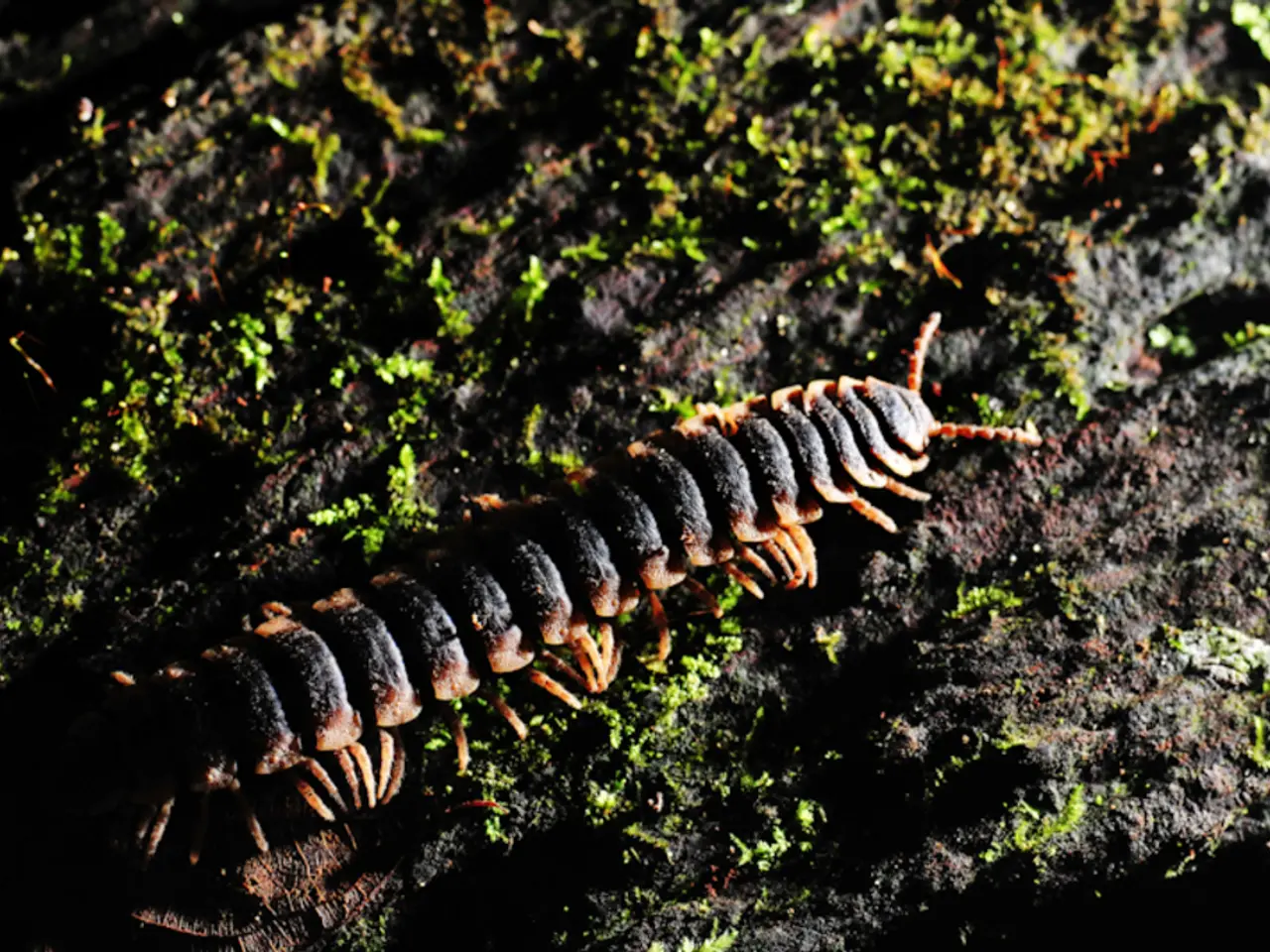
Many-legged Insects Showdown: Identifying Centipedes from Millipedes
In the world of small, multi-legged creatures, two of the most intriguing are centipedes and millipedes. Despite their similar appearance, these creatures have distinct differences in body structure, diet, habitats, defense mechanisms, lifecycle, and environmental roles.
Body Structure
Centipedes have flattened, elongated bodies with one pair of legs per segment, legs splayed out to the sides, and typically a more agile and sleek appearance. On the other hand, millipedes have cylindrical, more robust bodies with two pairs of legs per segment, giving them a denser look. Their legs are shorter and closer under the body, contributing to their slower movement.
Diet
Centipedes are carnivorous predators feeding on insects and small arthropods, using venomous claws (forcipules) to capture prey. In contrast, millipedes are detritivores, feeding mostly on decaying plant material and organic matter; they do not bite or hunt.
Habitats
Both live in moist environments like soil, leaf litter, under bark, stones, or wood debris. Centipedes prefer places that allow fast movement and hunting, while millipedes are found where they can feed on decomposing materials.
Defense Mechanisms
Centipedes rely on speed and venomous bites to defend themselves. Their venom can cause painful bites to humans. Millipedes defend by curling into a spiral to protect their softer underside and may release irritating, foul-smelling chemical secretions to deter predators. They are generally harmless and non-aggressive.
Lifecycle
Centipedes tend to develop by adding segments and legs progressively with each molt and are relatively fast growers. Millipedes also add segments with molts but have longer developmental cycles and tend to live longer.
Role in the Environment
Centipedes serve as important natural pest controllers by preying on insects, helping regulate their populations. Millipedes play a crucial role in nutrient cycling by breaking down dead plant material, improving soil structure, and fostering microbial activity vital for soil health.
This distinction explains why centipedes are often feared for their speed and venom, whereas millipedes are usually considered beneficial decomposers in gardens and natural ecosystems. Understanding these differences can help us appreciate these fascinating creatures and their unique contributions to our environment.
[1] National Geographic Society. (2021). Millipedes. https://www.nationalgeographic.org/animals/invertebrates/m/millipedes/
[2] The Spruce Pets. (2021). Centipedes: Facts, Identification, and Control. https://pets.thespruce.com/centipedes-2657860
[3] University of California Agriculture and Natural Resources. (2021). Millipedes and Centipedes. https://ucanr.edu/sites/Entomology/files/307966.pdf
[4] University of California Los Angeles. (2021). Millipedes. https://www.integratedpestmanagement.ucanr.edu/PMG/PESTNOTES/pn74105.html
- To maintain a healthy garden, environmental-science suggests utilizing technology to create an optimal home-and-garden conditions for millipedes, as they play a crucial role in nutrient cycling by breaking down dead plant material and improving soil structure.
- The health of our environment is greatly influenced by the presence of science-driven technology, as it aids in understanding the unique environmental roles and defense mechanisms of creatures such as centipedes and millipedes, helping us appreciate and conserve them better.
- Our lifestyle choices impact the world around us, and giving preference to eco-friendly products like organic fertilizers can help promote the growth of beneficial creatures like millipedes in home-and-garden settings, fostering a healthier environment.